

Website speed can make or break a small business online today. You might think saving money with traditional hosting is a smart move. But with SSD hosting delivering website load times up to 300 percent faster than traditional HDD hosting, sticking with outdated technology could cost you customers and sales. There is a powerful shift happening and it is transforming what it means to succeed online.
Table of Contents
- Understanding Ssd Hosting For Modern Websites
- Key Benefits Of Ssd Hosting For Your Business
- Ssd Hosting Vs Traditional Hosting Explained
- How To Choose The Right Ssd Hosting Provider
Quick Summary
| Takeaway | Explanation |
|---|---|
| SSD hosting enhances website speed significantly | Small businesses can see up to 300% faster loading times compared to traditional HDD hosting, improving user experience and engagement. |
| Increased reliability with SSD technology | SSDs offer better data integrity, easier recovery, and fewer mechanical failures, ensuring consistent performance for websites. |
| Energy efficiency lowers operational costs | SSDs consume less power and produce less heat, translating to reduced energy expenses and a smaller carbon footprint. |
| Future-proof your business with SSD hosting | As web applications grow more complex, SSDs provide the necessary infrastructure to handle demands for speed and reliability. |
| Choose SSD providers based on performance and support | Evaluate providers on speed, uptime, security features, and responsive technical support to ensure reliable hosting. |
Understanding SSD Hosting for Modern Websites
Website performance is the heartbeat of online success. Small businesses and digital entrepreneurs recognize that hosting infrastructure plays a critical role in delivering exceptional user experiences. SSD hosting represents a technological leap forward in web hosting solutions, transforming how websites operate and perform.
What Makes SSD Hosting Different
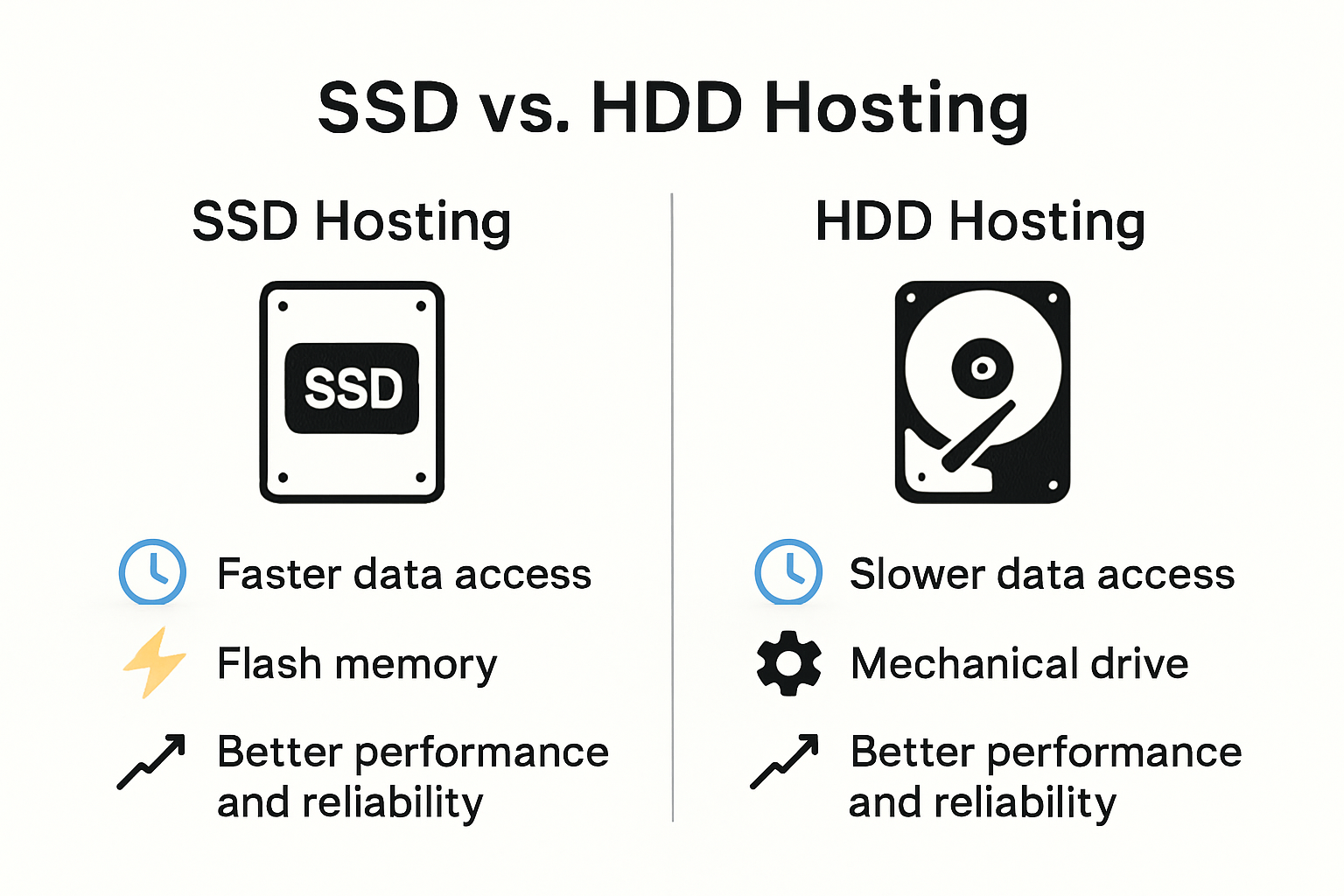
Traditional web hosting relied on Hard Disk Drives (HDDs), which use mechanical spinning disks to read and write data. In contrast, Solid State Drives (SSDs) utilize flash memory technology, delivering dramatically faster data access and transfer speeds. According to Bitcatcha, SSD hosting provides significant advantages over traditional storage methods, including increased speed, improved reliability, and faster recovery times.
The core difference lies in how data is processed. HDDs require physical movement of read/write heads across spinning platters, creating mechanical delays. SSDs eliminate these moving parts, enabling near-instantaneous data retrieval. This technological advancement translates directly into tangible benefits for website performance and user experience.
Performance and Business Impact
For small businesses, website speed is not just a technical metric but a critical competitive advantage. IntelligentHQ highlights that SSD hosting enhances website performance under high traffic conditions, providing lower latency and superior backup capabilities.
Consider these key performance benefits:
- Speed Optimization: SSD hosting can reduce website loading times by up to 300% compared to traditional HDD hosting.
- Reliability: Flash memory technology offers more consistent performance with fewer mechanical failure points.
- Energy Efficiency: SSDs consume significantly less power, contributing to reduced operational costs.
Small business websites running on SSD hosting experience faster page loads, improved search engine rankings, and enhanced user engagement. Google and other search engines prioritize websites with faster loading times, making SSD hosting a strategic investment for digital visibility.
Future-Proofing Web Infrastructure
CanSpace emphasizes that SSD hosting represents future-proof technology. As web applications become more complex and data-intensive, the need for rapid, reliable storage solutions becomes paramount.
Modern websites demand infrastructure that can handle dynamic content, complex databases, and increasing multimedia elements. SSD hosting provides the robust foundation necessary to meet these evolving digital demands. Whether you are running an ecommerce platform, a content-rich blog, or a complex web application, SSD hosting ensures your digital presence remains agile and responsive.
Choosing SSD hosting is not merely a technical decision but a strategic business move. It represents an investment in digital performance, user experience, and competitive advantage. As online competition intensifies, the right hosting infrastructure can make the difference between digital success and obscurity.
Key Benefits of SSD Hosting for Your Business
In the competitive digital marketplace, businesses need hosting solutions that deliver more than basic functionality. SSD hosting emerges as a game-changing technology that provides substantial advantages beyond traditional storage methods. Understanding these benefits can help small businesses make strategic infrastructure decisions that directly impact online performance and growth.
Performance and Speed Advantages
Speed is the cornerstone of digital success. According to InMotion Hosting, SSDs are 30% faster at opening files and booting up an operating system compared to traditional Hard Disk Drives (HDDs). This translates to dramatic improvements in website loading times and server responsiveness.
Websites hosted on SSD infrastructure experience near-instantaneous data retrieval. A server with SSD hosting takes approximately 10-13 seconds to reboot, compared to 30-40 seconds for HDD servers. For businesses, these milliseconds can mean the difference between capturing a customer or losing them to a competitor.
Here is a table summarizing the key performance and efficiency benefits of SSD hosting compared to traditional HDD hosting, as discussed above.
| Feature | SSD Hosting | Traditional HDD Hosting |
|---|---|---|
| Website Loading Time | Up to 300% faster | Slower |
| File/OS Opening Speed | 30% faster | Standard |
| Server Reboot Time | 10-13 seconds | 30-40 seconds |
| Data Access Method | Flash memory | Spinning disks |
| Power Consumption | Lower | Higher |
| Heat Generation | Minimal | Higher |
Reliability and Data Protection

CanSpace highlights critical reliability features of SSD hosting that protect business digital assets. The technology offers remarkable data integrity capabilities, with SSDs capable of maintaining data for over 300 years. Key reliability benefits include:
- Data Recovery: Easier data recovery in case of potential failures
- Predictive Maintenance: SSD servers provide advance warnings before potential failures occur
- Physical Durability: No moving mechanical parts reduce risk of physical damage
Unlike traditional HDDs with spinning platters and mechanical read/write heads, SSDs use flash memory technology. This design eliminates potential points of mechanical failure, providing a more stable and predictable hosting environment.
Energy Efficiency and Cost Optimization
EUKHost emphasizes the energy efficiency of SSD technology. These drives consume significantly less power and generate minimal heat compared to traditional hard drives. For businesses, this translates into tangible benefits:
- Reduced Energy Costs: Lower power consumption means decreased operational expenses
- Environmentally Friendly: Smaller carbon footprint supports sustainability goals
- Cooler Server Operations: Less heat generation improves overall server performance and longevity
Small businesses can leverage SSD hosting as a strategic investment. The technology offers a perfect blend of performance, reliability, and cost-effectiveness. By choosing SSD hosting, companies position themselves with cutting-edge infrastructure that supports rapid digital growth, enhances user experience, and provides a competitive edge in an increasingly digital world.
SSD Hosting vs Traditional Hosting Explained
Choosing the right hosting technology is a critical decision for small businesses navigating the digital landscape. The fundamental difference between SSD and traditional HDD hosting lies not just in storage mechanisms but in performance, reliability, and overall digital infrastructure capabilities.
Technical Architecture Differences
Amazon Web Services highlights the core technological distinctions between SSD and traditional hard drive hosting. Traditional Hard Disk Drives (HDDs) rely on mechanical spinning platters with read/write heads, creating inherent performance limitations. In contrast, Solid State Drives (SSDs) use flash memory technology, eliminating moving parts and enabling near-instantaneous data access.
The data transfer rates reveal a stark performance gap. While traditional HDDs typically achieve transfer speeds around 30-150 MBps, modern SSDs can reach up to 3,500 MBps. This dramatic speed difference translates directly into faster website loading times, quicker database queries, and more responsive web applications.
To help you easily compare the two approaches, here’s a table summarizing the core differences between SSD and traditional HDD hosting based on key architecture and performance aspects described above.
| Aspect | SSD Hosting | Traditional HDD Hosting |
|---|---|---|
| Data Storage Technology | Flash memory (no moving parts) | Mechanical spinning disks |
| Data Transfer Rate | Up to 3,500 MBps | 30–150 MBps |
| Mechanical Failure Risk | Minimal | Higher |
| Storage Density | Up to 100 TB | Standard |
| Latency | Lower | Higher |
| Power Consumption | Lower | Higher |
| Heat Generation | Less | More |
Performance and Operational Efficiency
TechTarget explains that SSDs provide higher performance with significantly lower latencies. This makes them particularly suited for mission-critical applications where every millisecond counts. Key performance distinctions include:
- Data Access Speed: SSDs offer substantially faster read/write operations
- Storage Density: Modern SSDs support up to 100 TB of storage
- Power Consumption: SSDs consume less electrical energy compared to traditional drives
Traditional hosting solutions struggle under high-traffic scenarios, experiencing performance bottlenecks during peak usage. SSD hosting maintains consistent performance levels, ensuring smooth user experiences even during traffic spikes.
Reliability and Future-Proofing
EdTech Magazine emphasizes the superior reliability of SSD technology. Without mechanical components, SSDs are inherently more durable and less prone to mechanical failures. The absence of moving parts means reduced risk of physical damage and improved long-term data integrity.
Additionally, SSDs generate less heat and require minimal cooling infrastructure. This not only reduces operational costs but also contributes to a more stable hosting environment. For small businesses, this translates to more predictable hosting performance and lower maintenance expenses.
The transition from traditional to SSD hosting represents more than a technological upgrade—it’s a strategic investment in digital infrastructure. As web applications become increasingly complex and user expectations for speed and reliability continue to rise, SSD hosting provides the robust, future-proof foundation that modern businesses require.
How to Choose the Right SSD Hosting Provider
Selecting the right SSD hosting provider is a critical decision that can significantly impact your online business performance. Not all hosting solutions are created equal, and understanding the nuanced factors that distinguish top-tier providers will help you make an informed investment.
Performance and Technical Capabilities
Web Hosting Wiki emphasizes that choosing an SSD hosting provider goes beyond basic storage considerations. Performance metrics are crucial in determining the right hosting solution for your business needs.
Key performance indicators to evaluate include:
- Data Transfer Speeds: Measure actual read/write speeds of SSD infrastructure
- Server Response Times: Assess latency and quick content delivery
- Scalability Options: Ensure the provider can accommodate business growth
- Uptime Guarantees: Look for providers offering 99.9% or higher uptime commitments
Businesses should conduct thorough performance testing and request detailed specifications about their SSD hosting infrastructure. Transparent providers will readily share technical details about their server configurations and performance benchmarks.
Security and Support Considerations
Adopt the Web highlights critical factors beyond raw performance. Security and technical support are paramount when selecting an SSD hosting provider. Look for comprehensive security features such as:
- DDoS Protection: Robust defense mechanisms against potential cyber attacks
- SSL Certificates: Free or affordable secure socket layer implementations
- Regular Backups: Automated and comprehensive data protection strategies
- 24/7 Technical Support: Responsive and knowledgeable support teams
The quality of technical support can make a substantial difference during critical moments. Providers offering multiple support channels like live chat, phone, and email demonstrate commitment to customer success.
Cost and Infrastructure Quality
Micron21 warns against selecting hosting providers based solely on price. Enterprise-grade SSD hosting requires significant infrastructure investments.
Consider these financial and infrastructure factors:
- Server Locations: Proximity to target audience impacts website performance
- Hardware Quality: Enterprise-grade SSD storage ensures better reliability
- Pricing Transparency: No hidden fees or complex billing structures
- Resource Allocation: Clear understanding of storage, bandwidth, and processing capabilities
A comprehensive evaluation involves balancing cost with performance, security, and support quality. The cheapest option rarely provides the best long-term value for businesses seeking reliable digital infrastructure.
Ultimately, choosing an SSD hosting provider is about finding a strategic technology partner. The right provider will offer a robust, secure, and scalable solution that grows alongside your business, ensuring your digital presence remains fast, reliable, and competitive in an increasingly complex online marketplace.
Frequently Asked Questions
What is SSD hosting?
SSD hosting is a web hosting solution that uses Solid State Drives (SSDs) to store data, which offers significantly faster loading times and improved performance compared to traditional Hard Disk Drive (HDD) hosting.
How much faster is SSD hosting compared to traditional hosting?
SSD hosting can deliver website loading times up to 300% faster than traditional HDD hosting, leading to improved user experience and engagement on websites.
What are the main benefits of using SSD hosting for small businesses?
The main benefits of SSD hosting include faster website speed, increased reliability, better data protection, lower energy consumption, and future-proof infrastructure that can support complex web applications.
How do I choose the right SSD hosting provider for my business?
To choose the right SSD hosting provider, evaluate their performance capabilities, security features, customer support, and pricing transparency. Look for providers that offer high uptime guarantees and responsive technical support.
Ready to Accelerate Your Website Growth with SSD Hosting?
If your business is losing customers to slow website speeds or outdated hosting, now is the time to act. The article above highlights exactly how speed, uptime, and data security are critical for today’s online success. At Beta Host 247, we understand that your website’s performance can determine whether visitors stay or leave. That is why our hosting solutions are built around fast SSD storage, LiteSpeed technology, and proven security features. Whether you need WordPress managed hosting, scalable VPS, or robust dedicated servers, our plans are designed to solve the pain points mentioned throughout this guide.
Take control of your business growth and boost your online reputation with reliable, future-proof infrastructure. Visit Beta Host 247 today to discover hosting plans that deliver up to 300 percent faster load times and unmatched reliability. Explore our hosting options or get started now to secure exclusive offers for high-speed, secure, and scalable SSD hosting designed for your success.