
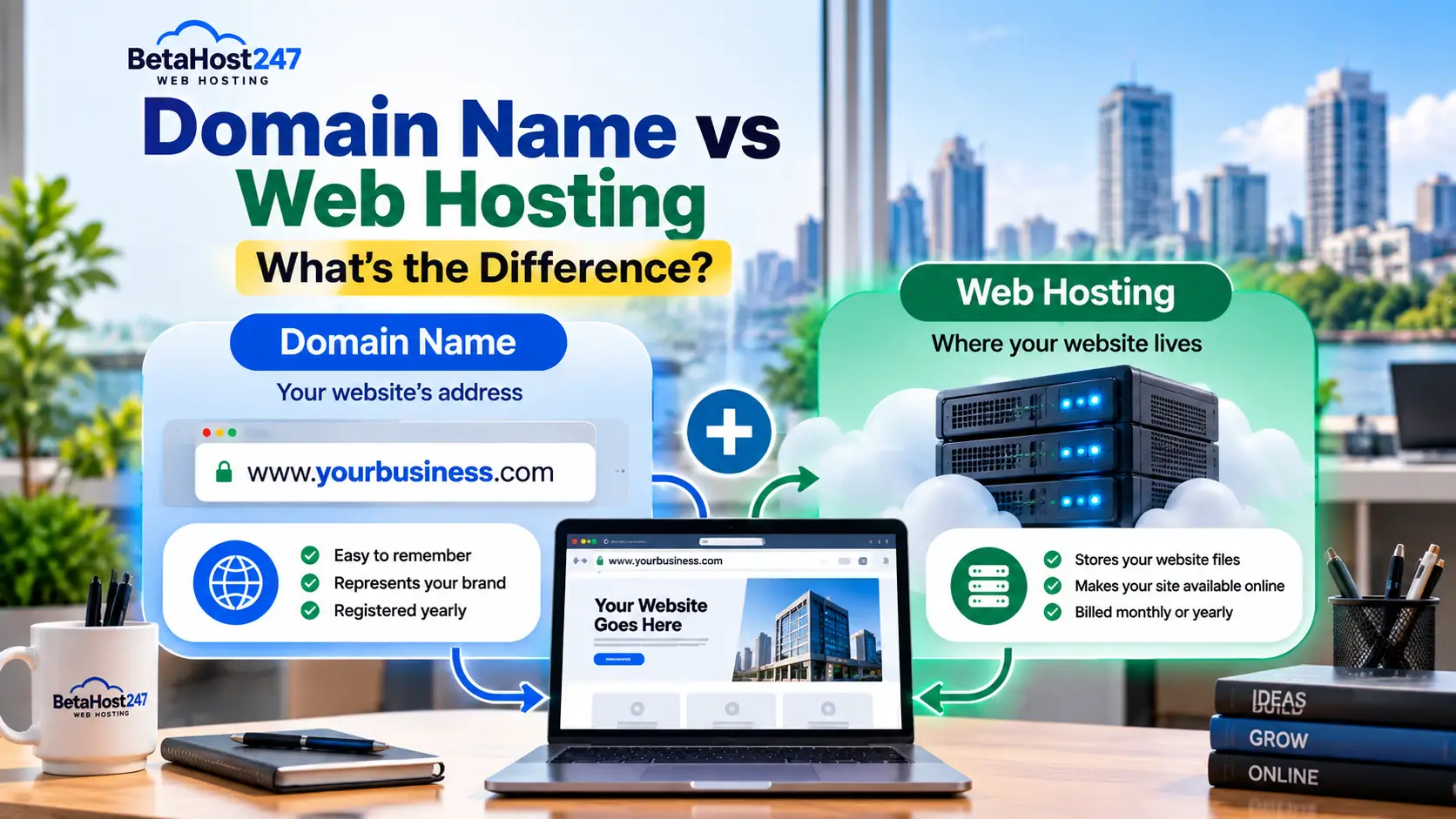
Domain Name vs Web Hosting: What’s the Difference?
If you are creating your first website, two terms you will encounter almost immediately are domain name and web hosting.
They are closely connected, but they are not the same thing.
A domain name is the address people use to find your website, such as example.com. Web hosting is the service that stores your website files and makes them available online.
In simple terms:
Domain name = your website’s address
Web hosting = where your website lives
Most websites need both a domain name and web hosting to operate normally.
This guide explains the difference between a domain and hosting, how they work together, what each one costs, and what you need when starting a website.
What Is a Domain Name?
A domain name is the human-readable address visitors enter into a browser to reach a website.
Examples include:
google.com
wikipedia.org
betahost247.com
Without domain names, internet users would have to rely on numerical IP addresses and other technical information to locate servers.
Domain names make websites much easier to identify, remember and access.
What Is Web Hosting?
Web hosting is a service that provides server resources for storing and delivering website content over the internet.
Your website may contain:
- HTML files
- WordPress files
- Images
- Videos
- Databases
- CSS files
- JavaScript
- Email data
- Application files
These files need to be stored on a server that can respond when visitors request your website.
That’s the role of web hosting.
Domain Name vs Web Hosting: Quick Comparison
| Feature | Domain Name | Web Hosting |
|---|---|---|
| Purpose | Website address | Stores and serves website data |
| Example | example.com | Hosting server/account |
| Usually renewed | Yearly | Monthly, yearly or other billing cycle |
| Stores website files | No | Yes |
| Can exist without website | Yes | Yes |
| Needed for most websites | Yes | Yes |
| Managed through | Domain registrar | Hosting provider/control panel |
The easiest way to understand the difference is with an analogy.
Think of a Domain as an Address and Hosting as a House
Imagine you’re building a house.
The house contains your belongings.
The address tells people where to find the house.
Your website works similarly.
Your web hosting is like the house because it contains your website’s files and data.
Your domain name is like the address visitors use to reach it.
Having an address without a house doesn’t give visitors much to see.
Having a house without an easy-to-use address makes it difficult for people to find.
That’s why domains and hosting usually work together.
How Do Domain Names and Web Hosting Work Together?
When someone enters your domain name into their browser, the Domain Name System, commonly called DNS, helps direct the request toward the appropriate server.
The process can be simplified like this:
Visitor enters domain → DNS identifies destination → hosting server receives request → website is returned to visitor
This happens very quickly.
The domain doesn’t contain the actual website.
Instead, DNS records associated with the domain help identify where services such as the website should be reached.
Do I Need Both a Domain and Web Hosting?
For a normal public website, usually yes.
You need:
A domain name so visitors have a recognizable address.
Web hosting so your website files have somewhere to run and be delivered from.
There are exceptions.
For example, you can register a domain without building a website immediately.
Likewise, developers can access some servers using an IP address or temporary hostname without connecting a permanent domain.
But for a normal business, blog or ecommerce website, you’ll generally want both.
Can I Buy a Domain Without Hosting?
Yes.
You can register a domain name without purchasing web hosting.
People sometimes do this because they:
- Want to reserve a business name
- Plan to build the website later
- Want to protect a brand name
- Intend to transfer the domain later
- Need the domain for another online service
Registering a domain doesn’t automatically create a website.
You’ll still need hosting or another website platform when you’re ready to publish the site.
Can I Buy Hosting Without a Domain?
Yes.
You can purchase hosting before registering or connecting a domain.
However, if you want visitors to access the finished website through a conventional domain such as yourcompany.com, you’ll eventually need to connect one.
Some hosting environments provide temporary addresses for development or testing.
Can My Domain and Hosting Be With Different Companies?
Yes.
Your domain registrar and web hosting provider don’t have to be the same company.
For example, you could register your domain with one company and host your website with another.
You then configure the domain’s DNS or nameservers to direct traffic to the hosting service.
This setup is very common.
Using one provider for both can make management simpler, but it isn’t technically required.
What Are Nameservers?
Nameservers are part of the DNS system.
They help determine which DNS provider is authoritative for your domain.
When purchasing hosting, your provider may give you nameservers such as:
ns1.examplehost.com
ns2.examplehost.com
You can configure those nameservers at your domain registrar.
After DNS changes propagate, requests can be directed according to the DNS records managed through those nameservers.
What Is DNS?
DNS stands for Domain Name System.
It translates human-friendly domain names into information computers use to locate internet services.
Common DNS records include:
A record – points a hostname toward an IPv4 address.
AAAA record – points a hostname toward an IPv6 address.
CNAME record – creates an alias to another hostname.
MX record – specifies mail servers.
TXT record – stores text-based information often used for verification and email-security configurations.
DNS is one of the technologies that connects your domain name to services such as web hosting and email.
What Happens After You Buy a Domain?
Registering a domain gives you the right to use that domain for the registration period, subject to the registrar’s terms and applicable registration rules.
You can then:
- Connect it to web hosting
- Configure DNS
- Create subdomains
- Configure email services
- Redirect it
- Renew it before expiration
Buying the domain alone doesn’t mean your website is online.
You still need to configure where the domain should point.
What Happens After You Buy Web Hosting?
Once your hosting account is activated, you can normally begin setting up your website.
Depending on the hosting service, you may be able to:
- Upload website files
- Install WordPress
- Create databases
- Create email accounts
- Add domains
- Configure SSL
- Change PHP settings
- Manage files through a control panel
If you already own a domain, you’ll connect it to the hosting account.
Which Should You Buy First: Domain or Hosting?
Either can technically come first.
However, many people find it easier to decide on and register their domain early.
A practical sequence is:
1. Choose your domain name
2. Register the domain
3. Choose an appropriate hosting plan
4. Connect the domain to the hosting
5. Install or upload the website
6. Configure SSL
7. Test the website
8. Launch
If your preferred domain is important to your brand, registering it early can prevent someone else from registering it while you’re still developing the website.
Domain Registration vs Web Hosting Cost
Domains and hosting usually use different pricing structures.
A domain is commonly registered and renewed annually.
Hosting may be billed:
- Monthly
- Quarterly
- Semi-annually
- Annually
- Over longer periods
Domain prices vary depending on the extension.
For example, .com, .net, .org, .ng and .com.ng may have different registration and renewal prices.
Hosting prices vary according to resources and service type.
Shared hosting is usually cheaper than VPS hosting because they’re designed for different workloads.
For more information about hosting prices, read our guide on how much web hosting costs in Nigeria.
What Is a Domain Extension?
The final part of a domain is called the top-level domain or TLD.
Examples include:
.com
.net
.org
.ng
.com.ng
The right extension depends on your organization, target audience, availability and branding strategy.
A Nigerian business may consider Nigerian extensions such as .ng or .com.ng, while .com remains widely recognized internationally.
The extension doesn’t replace web hosting. It is simply part of the domain name.
What Is Shared Hosting?
Shared hosting allows multiple customer hosting accounts to operate within a shared server environment.
It’s commonly used for:
- Small businesses
- Blogs
- Personal websites
- Portfolios
- New websites
Because server infrastructure is shared, it is usually one of the more affordable ways to host a website.
If you’re deciding between different hosting levels, read our Shared Hosting vs VPS Hosting comparison.
What Is VPS Hosting?
A Virtual Private Server provides an isolated virtual server environment with allocated resources.
VPS hosting is generally more suitable when you need:
- More server resources
- Root access
- Custom software
- Greater configuration control
- More demanding applications
A VPS costs more than typical shared hosting and may require greater technical knowledge.
Not every website needs one.
What About WordPress Hosting?
WordPress hosting is hosting intended for websites built with WordPress.
Depending on the provider, it may include resources, configuration or tools specifically suited to WordPress websites.
Remember that WordPress isn’t a domain name.
A typical WordPress website still uses:
Domain + Hosting + WordPress software
These are separate components.
Domain vs Hosting vs Website
These three terms are often confused.
Here’s the difference:
Domain: the address.
Hosting: the server environment.
Website: the actual content/application visitors interact with.
For example:
Your domain could be:
mybusiness.com
Your hosting stores the website.
The website itself contains your pages, images, text, forms and applications.
Is Email Hosting the Same as Web Hosting?
Not exactly.
Email hosting provides infrastructure for sending and receiving email using addresses such as:
Some web hosting packages include email hosting, while others don’t.
Your domain can also use one provider for the website and another provider for email through DNS configuration.
Before purchasing hosting, check whether email accounts are included if you need them.
Can I Move My Website Without Changing My Domain?
Yes.
You can migrate a website to another hosting provider while keeping the same domain name.
Typically, the process involves:
- Backing up the website
- Moving files and databases
- Configuring the new hosting account
- Testing the migrated website
- Updating DNS or nameservers
- Waiting for DNS changes to propagate
- Verifying the website and email
Visitors can continue using the same domain.
Only the hosting destination changes.
Can I Transfer My Domain Without Moving My Website?
Yes.
Domain registration and hosting are independent.
You can transfer domain management to another registrar while keeping the website on the existing hosting server.
DNS needs to remain correctly configured during the process.
Do I Own My Domain Forever?
Domain registration isn’t normally a one-time permanent purchase.
You register the right to use a domain for a specified period and renew it to maintain the registration.
If you allow the domain to expire and don’t recover it within applicable renewal or redemption periods, you may eventually lose control of it.
That’s why keeping domain contact information and renewal settings up to date is important.
Common Domain and Hosting Mistakes
Beginners frequently make a few avoidable mistakes.
Forgetting Domain Renewal
Losing access to a domain can disrupt websites and email.
Keep track of expiration dates.
Buying Hosting Based Only on Storage
CPU, RAM, support, security and other resources matter too.
Assuming Hosting Includes a Domain
Some hosting packages include domain offers and others don’t.
Check before purchasing.
Changing DNS Without Understanding the Existing Records
Changing nameservers or DNS records can affect websites and email.
Keep a copy of important DNS records before making major changes.
Assuming a Domain Transfer Moves the Website
It doesn’t.
Moving domain registration and migrating website hosting are separate processes.
Frequently Asked Questions
Is a domain name the same as web hosting?
No. A domain is the address used to reach a website. Web hosting provides the server resources where the website runs and its data is stored.
Can I have a domain without hosting?
Yes. You can register and maintain a domain without hosting a website on it.
Can I have web hosting without a domain?
Yes, although you’ll normally connect a domain when you’re ready to make a conventional public website accessible.
Do I need hosting if I already bought a domain?
If you want to host a conventional website, you’ll need a hosting service or another platform capable of serving the website.
Can I use different companies for domain and hosting?
Yes. You can register your domain with one provider and host the website with another.
Does transferring a domain transfer my website?
No. A domain transfer changes the registrar responsible for the domain registration. Website migration is a separate process.
Final Thoughts
The difference between a domain name and web hosting becomes simple once you understand what each one does.
Your domain is your website’s address.
Your hosting provides the infrastructure where your website operates.
For most websites, you need both.
Choose a domain that’s easy for customers to recognize, then select hosting based on your website’s actual requirements rather than simply buying the biggest or cheapest package available.
Understanding the difference from the beginning will make managing your website, DNS, email and future migrations much easier.