
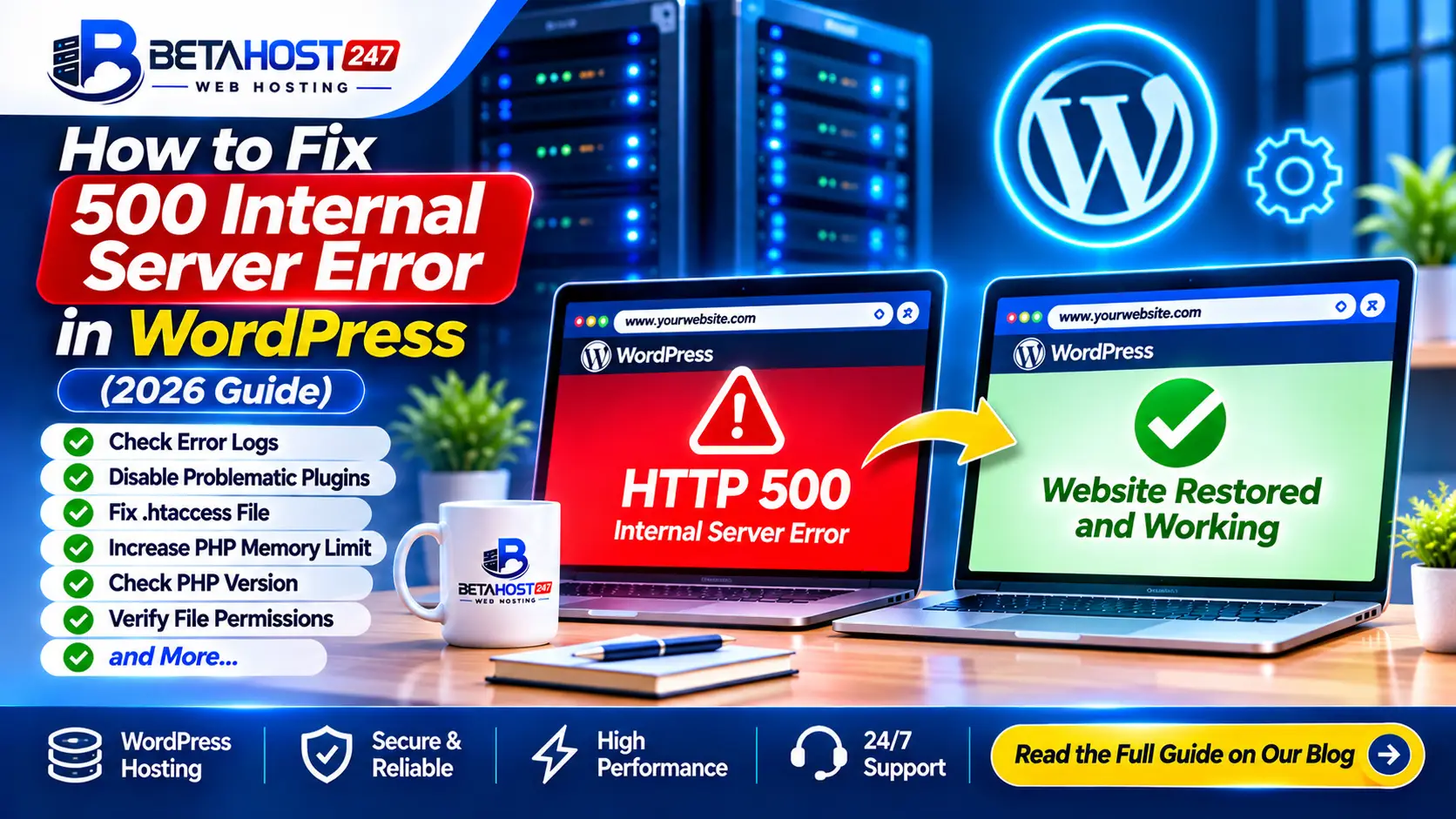
How to Fix 500 Internal Server Error in WordPress (2026 Guide)
You open your WordPress website, expecting everything to work normally, but instead of your homepage, you see:
500 Internal Server Error
Sometimes, the message appears as:
- HTTP ERROR 500
- Internal Server Error
- The server encountered an internal error
- This page isn’t working
- The server is unable to complete your request
This error can prevent visitors from accessing your website and may also affect your WordPress administration dashboard.
The good news is that many WordPress 500 errors can be resolved without rebuilding your website.
To fix a 500 Internal Server Error in WordPress, start by checking your server error logs, then investigate recent plugin or theme changes, .htaccess configuration, PHP errors and hosting resource limits.
This guide explains the common causes and provides practical troubleshooting steps for WordPress websites using cPanel, LiteSpeed, Apache and other compatible hosting environments.
What Is a 500 Internal Server Error?
An HTTP 500 Internal Server Error means the server encountered an unexpected condition that prevented it from completing a request.
Unlike a 404 error, which normally indicates that a requested page cannot be found, a 500 error indicates a server-side failure.
However, the HTTP 500 status code doesn’t identify the exact cause.
The problem could originate from WordPress, PHP, server configuration, a plugin, a theme or another application component.
That’s why examining the error logs is usually more useful than guessing.
What Causes a 500 Internal Server Error in WordPress?
Common causes include:
- Plugin conflicts or faulty plugin updates
- Theme errors
- Invalid
.htaccessdirectives - PHP fatal errors
- PHP memory exhaustion
- Incompatible PHP versions
- Incorrect file permissions
- Failed WordPress updates
- Corrupted application files
- Hosting resource exhaustion
- Server configuration problems
- Malicious code or compromised website files
A 500 error may also appear immediately after a website migration or configuration change.
The correct solution depends on what actually failed.
Step 1: Check Your WordPress and Server Error Logs
Before changing files, investigate the error logs.
Logs can reveal the underlying cause, such as a PHP fatal error, missing file, invalid directive or memory exhaustion.
How to Check Error Logs in cPanel
- Log in to your cPanel account.
- Navigate to Metrics → Errors, if available.
- Review the most recent error messages.
- Check the time when the 500 error occurred.
- Look for references to WordPress plugins, themes or PHP files.
Depending on the hosting configuration, additional error logs may exist in your website directory or be available through your hosting provider.
Common Error Messages
Examples include:
PHP Fatal Error: A PHP script encountered an unrecoverable problem.
Allowed Memory Size Exhausted: A PHP process exceeded its configured memory limit.
Invalid Command: The server encountered a configuration directive it couldn’t process.
Permission Denied: The application or server couldn’t access a required resource.
The exact wording varies by environment.
If you don’t understand the log message, save the relevant error details and contact your hosting provider.
Avoid publicly sharing logs containing sensitive paths, credentials or customer information.
Step 2: Create a Backup Before Making Changes
Before troubleshooting, create a backup of your WordPress files and database if possible.
A complete backup should include:
- WordPress core files
- Plugins and themes
- Uploaded media
wp-config.php- Database
- Custom configuration files
If your website is already inaccessible, you may still be able to access its files through cPanel File Manager or SFTP.
You may also be able to export the database using phpMyAdmin.
Store backup copies securely outside the affected hosting account.
Step 3: Disable WordPress Plugins Temporarily
A faulty or incompatible plugin is a common cause of WordPress errors.
The problem may appear after:
- Installing a new plugin
- Updating an existing plugin
- Changing PHP versions
- Updating WordPress
- Enabling a new plugin feature
If You Can Access WordPress Dashboard
- Log in to WordPress.
- Navigate to Plugins → Installed Plugins.
- Deactivate a recently changed plugin.
- Test the website.
- Repeat until you identify the problem.
If there is no obvious recent change, you can test by temporarily deactivating plugins, ideally on a staging copy.
If You Cannot Access WordPress Dashboard
You can temporarily disable standard plugins through File Manager.
- Log in to cPanel.
- Open File Manager.
- Navigate to your WordPress installation.
- Open
wp-content. - Rename the
pluginsdirectory toplugins-disabled. - Test your website.
For example:
public_html/wp-content/plugins
Rename to:
public_html/wp-content/plugins-disabled
If the website begins working, a plugin may be responsible.
Restore the original directory name and investigate individual plugins.
Important: Disabling plugins can interrupt payment processing, security protections, contact forms and other business functions. Perform this test carefully and restore essential functionality promptly.
Step 4: Check Your .htaccess File
The .htaccess file contains configuration directives used by Apache and compatible web servers.
WordPress commonly uses it for permalink rewriting.
Invalid directives or conflicting rules can sometimes cause HTTP 500 errors.
How to Test .htaccess in cPanel
- Open cPanel File Manager.
- Enable Show Hidden Files in File Manager settings.
- Navigate to your WordPress installation directory.
- Locate
.htaccess. - Download a backup copy.
- Rename it to
.htaccess-backup. - Test your website.
If the error disappears, investigate the original file.
Regenerate WordPress Permalink Rules
If your WordPress dashboard is accessible:
- Navigate to Settings → Permalinks.
- Leave your existing permalink structure selected.
- Click Save Changes.
WordPress may regenerate its standard rewrite rules if the file is writable.
If necessary, the standard WordPress rewrite block for a root-directory installation is:
# BEGIN WordPress
<IfModule mod_rewrite.c>
RewriteEngine On
RewriteRule .* - [E=HTTP_AUTHORIZATION:%{HTTP:Authorization}]
RewriteBase /
RewriteRule ^index\.php$ - [L]
RewriteCond %{REQUEST_FILENAME} !-f
RewriteCond %{REQUEST_FILENAME} !-d
RewriteRule . /index.php [L]
</IfModule>
# END WordPress
These rules are an example for a typical root-directory installation. Subdirectory installations or custom configurations may require different rules.
Don’t overwrite existing security, redirect or application-specific rules without reviewing them.
Also note that not every web server uses .htaccess.
Step 5: Check Your PHP Memory Limit
WordPress and its plugins require memory to execute PHP scripts.
If a script exceeds its available PHP memory limit, it may trigger a fatal error.
The resulting HTTP response may be a 500 error.
How to Identify PHP Memory Exhaustion
Check your error logs for messages similar to:
Allowed memory size of ... bytes exhausted
If the logs confirm memory exhaustion, investigate which process requires additional memory.
How to Increase PHP Memory Limit
Depending on your hosting configuration, you may be able to change the PHP memory limit through cPanel’s PHP settings.
In some WordPress installations, you can also request a higher WordPress memory limit by adding the following to wp-config.php:
define( 'WP_MEMORY_LIMIT', '256M' );Place it before the line indicating that WordPress configuration editing should stop.
This setting requests a WordPress memory limit but cannot override a lower hard limit enforced by the hosting environment.
If the constant already exists, edit the existing value instead of creating a duplicate.
Don’t increase memory indefinitely. Repeated memory exhaustion may indicate a plugin problem, inefficient code or an application that needs additional resources.
Step 6: Check Your PHP Version
An incompatible PHP version can cause WordPress applications to fail.
For example, an older plugin may use PHP functionality that has been removed in newer releases.
Similarly, outdated PHP versions may lack features required by current WordPress software.
How to Check PHP Version in cPanel
- Log in to cPanel.
- Locate MultiPHP Manager, Select PHP Version or the equivalent tool available on your server.
- Check the PHP version assigned to your website.
- Compare it with your WordPress, plugin and theme requirements.
- Test a compatible, supported PHP version.
Avoid switching to an unsupported PHP version merely to make an outdated plugin work.
For detailed instructions, read:
How to Change PHP Version in cPanel
Step 7: Check WordPress Theme Compatibility
A theme can also cause a 500 error.
This may happen after:
- A theme update
- A PHP version change
- A WordPress core update
- Editing theme functions
- Installing a theme extension
If the problem began immediately after a theme change, consider restoring the previous version from a verified backup or switching to a maintained default WordPress theme.
If you cannot access the dashboard, use a staging environment or an administrator-supported recovery method.
Avoid deleting the active theme directory without a recovery plan.
Custom themes may contain important functionality that isn’t available in a default theme.
Step 8: Check File and Folder Permissions
Incorrect permissions can prevent the web server from accessing required files.
Typical WordPress environments commonly use:
- Directories:
755 - Files:
644
These are general examples, not universal requirements.
The correct settings depend on the server’s ownership and permission model.
Avoid using 777 permissions as a troubleshooting shortcut.
If you suspect file ownership problems, contact your hosting provider rather than recursively changing permissions without understanding the server configuration.
Step 9: Enable WordPress Debug Logging
WordPress includes debugging options that may help identify PHP errors.
Open wp-config.php and review the existing debug settings.
For temporary troubleshooting, you may use:
define( 'WP_DEBUG', true );
define( 'WP_DEBUG_LOG', true );
define( 'WP_DEBUG_DISPLAY', false );
If these constants already exist, modify them rather than adding duplicates.
When supported and writable, WordPress may record application errors in:
wp-content/debug.log
Review the log for relevant fatal errors.
Important Security Precautions
- Don’t display detailed errors to public visitors.
- Restrict access to debug logs.
- Avoid leaving debugging enabled unnecessarily.
- Remove or secure diagnostic files after troubleshooting.
Some failures occur before WordPress initializes its debugging system, so server-level logs may still be necessary.
Step 10: Check Hosting CPU, RAM and Resource Limits
A hosting account that repeatedly exceeds its resource limits may experience failed requests or application errors.
Possible causes include:
- High CPU usage
- Memory exhaustion
- Excessive concurrent processes
- Heavy plugins
- Inefficient database queries
- Background tasks
- Malicious bot activity
In cPanel, check Metrics → Resource Usage if the feature is available.
Review whether the account has reached CPU, physical memory, entry-process or other relevant limits.
Not every resource-limit event results in HTTP 500. Some environments return different status codes.
For WordPress-specific resource troubleshooting, read:
How to Fix High CPU Usage in WordPress
Step 11: Check for Failed WordPress Updates
An interrupted WordPress update can leave files incomplete or inconsistent.
This may happen because of:
- Connection interruptions
- File permission problems
- Insufficient storage
- Incomplete uploads
- Update conflicts
If the error began during an update, check whether WordPress files were updated successfully.
You may need to restore from a verified backup or carefully reinstall clean WordPress core files.
Don’t overwrite wp-content, wp-config.php or other important custom files.
If you’re unfamiliar with manual WordPress repairs, seek technical assistance.
Step 12: Investigate Malware or Unauthorized Changes
A compromised WordPress website may contain malicious PHP code, modified configuration files or unauthorized plugins.
Warning signs can include:
- Unexpected administrator accounts
- Unknown files
- Suspicious redirects
- Modified PHP scripts
- Malware warnings
- Unexplained website errors
If you suspect a compromise, preserve relevant evidence, restrict unauthorized access and investigate the cause.
Restore from a verified clean backup when appropriate, patch the vulnerability and rotate affected credentials.
Don’t assume every 500 error is caused by malware.
Step 13: Contact Your Hosting Provider
If you’ve completed the basic checks and the error continues, contact your hosting provider.
Provide:
- Your website domain
- When the error started
- Whether the error affects all pages
- Recent plugin, theme or PHP changes
- Relevant error-log messages
- Steps you’ve already attempted
This information can help the support team investigate more efficiently.
If you’re using a VPS or dedicated server, the server administrator may also need to inspect PHP-FPM, web server and system logs.
How to Prevent 500 Internal Server Errors in WordPress
You can’t prevent every server-side failure, but you can reduce common risks.
Keep Software Updated
Maintain supported versions of WordPress, PHP, plugins and themes.
Test Major Changes
Use a staging environment for significant updates and configuration changes.
Maintain Independent Backups
Keep website files and database backups outside your hosting account.
Monitor Server Resources
Investigate recurring CPU, memory and process-limit problems.
Review Error Logs
Check application errors before they become repeated outages.
Use Reliable Hosting
Choose a hosting environment with resources and support appropriate for your website.
Avoid Unnecessary Plugins
Remove abandoned extensions and unnecessary functionality.
Can a 500 Internal Server Error Affect SEO?
Yes, especially when it persists.
Search engines need to access your website to crawl and index its pages.
If important pages repeatedly return HTTP 500 responses, search engines may temporarily reduce crawling activity.
Prolonged server errors can eventually affect indexing and search visibility.
After fixing the problem:
- Confirm that important pages load normally.
- Check their HTTP status codes.
- Review Google Search Console.
- Investigate reported server errors.
- Monitor the website for recurring failures.
Don’t request indexing until the website is working correctly.
WordPress Hosting and Server Errors at Beta Host
A stable WordPress website depends on suitable hosting resources, application compatibility and proper maintenance.
Beta Host Limited provides hosting services for different website requirements.
Explore:
For smaller websites, shared or WordPress hosting may provide sufficient resources.
Websites requiring more server control or additional resources may benefit from VPS hosting.
Before upgrading, investigate the cause of recurring errors. A larger hosting package won’t automatically fix broken plugins or invalid configuration files.
Frequently Asked Questions
What does HTTP 500 mean in WordPress?
It means the server encountered an unexpected condition that prevented it from completing the request. The status code alone doesn’t identify the exact cause.
Can a WordPress plugin cause a 500 error?
Yes. Faulty, incompatible or outdated plugins can trigger PHP errors that result in HTTP 500 responses.
Can .htaccess cause a 500 Internal Server Error?
Yes. Invalid directives in .htaccess can cause errors on Apache and compatible servers.
Will increasing PHP memory fix a 500 error?
Only if memory exhaustion is the underlying cause. Check the error logs before changing memory limits.
Does a 500 error mean my website has been hacked?
Not necessarily. Most troubleshooting should begin with logs, recent changes and configuration checks. Malware is only one possible cause.
Can I fix a 500 error through cPanel?
Many causes can be investigated through cPanel using File Manager, PHP settings, resource monitoring and error logs.
Does clearing my browser cache fix HTTP 500?
Usually not. HTTP 500 indicates a server-side failure. Clearing the browser cache may help rule out a cached error page, but it won’t repair the underlying server problem.
Should I reinstall WordPress to fix a 500 error?
Not as the first step. Diagnose the error before reinstalling. Reinstallation may not solve plugin, database or server configuration problems.
Final Thoughts
The 500 Internal Server Error in WordPress can be frustrating, but it doesn’t automatically mean your website is permanently damaged.
Start by checking the server error logs.
Then investigate recent plugin or theme changes, .htaccess, PHP compatibility, memory limits and hosting resource usage.
Make changes carefully, maintain backups and test your website after each troubleshooting step.
If the error persists, contact your hosting provider with the relevant diagnostic information.
The most effective way to fix a WordPress 500 error is to identify its actual cause rather than repeatedly changing settings without evidence.