
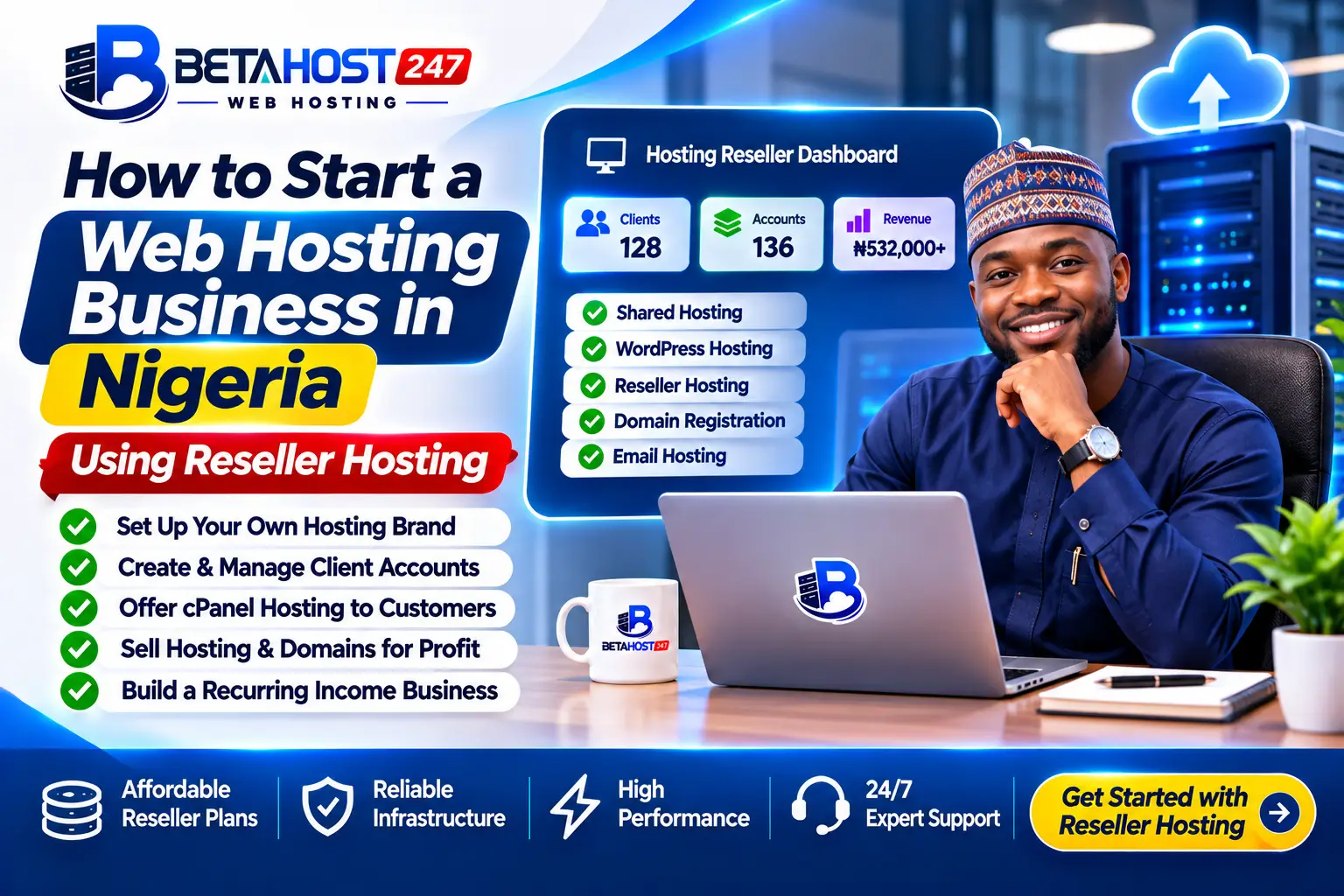
How to Start a Web Hosting Business in Nigeria Using Reseller Hosting (Guide)
Starting a web hosting business in Nigeria doesn’t necessarily require buying expensive servers, renting a data centre or becoming an experienced Linux administrator.
With reseller hosting, you can purchase hosting resources from an established provider and create hosting packages for your own customers.
This business model allows entrepreneurs, web developers, IT professionals and digital agencies to sell hosting services under their own brands.
But how does it work, how much does it cost, and what do you need to get started?
In this guide, we’ll explain how to start a web hosting business in Nigeria, set up reseller hosting, manage customers and build a sustainable hosting operation.
What Is a Web Hosting Reseller Business?
A reseller hosting business purchases hosting resources from a provider and sells hosting accounts to individual customers.
For example, instead of renting an entire dedicated server, you can purchase a reseller hosting package that allows you to create separate hosting accounts.
Each customer receives their own hosting account, subject to the resources and features you assign.
The reseller handles customer relationships, package pricing, billing and first-line support.
The upstream hosting provider manages the underlying server infrastructure according to the terms of the reseller service.
This makes reseller hosting an accessible way to enter the hosting industry.
Why Start a Web Hosting Business in Nigeria?
Businesses, schools, organisations, developers and entrepreneurs need websites and online applications.
Many also require:
- Domain registration
- Website hosting
- Business email
- SSL certificates
- Website migration
- Technical support
- Hosting account management
A reseller can offer these services to customers who prefer dealing with a local provider.
However, the market is competitive.
Success depends on service quality, customer retention, pricing, technical competence and effective marketing.
Step 1: Choose Your Target Customers
Before purchasing reseller hosting, identify the customers you want to serve.
Possible customer groups include:
Small businesses: Companies that need websites, professional email addresses and basic hosting.
Web developers: Professionals who build and maintain websites for clients.
Digital agencies: Businesses that want to bundle hosting with website maintenance.
Schools and organisations: Institutions that need websites and email services.
Entrepreneurs: Individuals launching blogs, portfolios or online businesses.
Choosing a target market helps you design suitable packages and marketing messages.
Step 2: Choose a Reseller Hosting Provider
Your upstream hosting provider plays an important role in your business.
If the underlying server becomes unavailable, your customers may experience problems even when your own billing and support systems are functioning.
Before choosing a provider, evaluate:
- Server performance
- Hosting resource allocations
- Account limits
- Available control panels
- Technical support
- Security features
- Backup arrangements
- Upgrade options
- Acceptable-use policies
- Renewal pricing
Also check whether the provider supports private nameservers and reseller branding.
Don’t select a provider based on price alone.
Step 3: Understand How Much Reseller Hosting Costs in Nigeria
The cost of starting a hosting business depends on the services and tools you choose.
For example, Beta Host Limited offers reseller hosting packages starting from ₦8,000 per month.
This represents the starting cost of the hosting package, not the complete cost of running a hosting company.
Additional expenses may include:
| Expense | Purpose |
|---|---|
| Reseller hosting | Hosting customer websites |
| Domain name | Your business website address |
| Business website | Displaying services and accepting enquiries |
| Billing software | Managing invoices and subscriptions |
| Payment processing | Accepting customer payments |
| Customer support | Handling technical requests |
| Marketing | Attracting customers |
| Backups | Protecting customer data |
Some of these costs are optional at the beginning, while others depend on your business model.
For example, you can initially manage a small number of customers manually before adopting automated billing software.
Step 4: Register Your Hosting Business
If you intend to operate a formal hosting business in Nigeria, consider registering the business with the Corporate Affairs Commission (CAC).
Business registration can support your professional identity and make it easier to establish relationships with payment providers and customers.
You should also consider appropriate tax, consumer protection, privacy and data-handling obligations.
The exact requirements depend on your business structure and activities.
Step 5: Purchase a Domain Name
Your hosting business needs a recognizable domain name.
Choose a name that is:
- Easy to remember
- Easy to spell
- Relevant to your business
- Suitable for long-term branding
- Available for registration
You can search for available domains through Beta Host Domain Registration.
After registering the domain, configure its DNS records according to your hosting setup.
Step 6: Purchase a Reseller Hosting Package
Once your business identity is ready, select a reseller hosting package.
Reseller hosting commonly provides access to Web Host Manager (WHM) or an equivalent account-management interface.
Depending on the package, you may be able to:
- Create customer hosting accounts
- Allocate disk space
- Set bandwidth limits
- Manage hosting packages
- Suspend or terminate accounts
- Configure nameservers
- Monitor account usage
Before purchasing, confirm the number of accounts allowed and the resources included.
Explore Reseller Hosting at Beta Host Limited.
Step 7: Set Up WHM and cPanel
WHM and cPanel serve different purposes.
WHM allows a reseller to manage hosting accounts and packages.
cPanel allows individual customers to manage their websites, databases, email accounts and other hosting features.
How to Create a Hosting Package in WHM
- Log in to your WHM reseller dashboard.
- Open Packages → Add a Package.
- Enter a package name.
- Configure the available storage and bandwidth.
- Select permitted account features.
- Save the package.
The exact options depend on your provider’s configuration and reseller permissions.
How to Create a Customer Account
- Open Account Functions → Create a New Account.
- Enter the customer’s domain.
- Provide the required account information.
- Select the hosting package.
- Review the configuration.
- Create the account.
Once created, the customer can receive their cPanel access details through an appropriate secure channel.
Step 8: Create Hosting Packages for Your Customers
Your packages should be understandable and financially sustainable.
For example, you might create three packages:
| Package | Target Customer |
|---|---|
| Starter | Personal websites and small blogs |
| Business | Small company websites |
| Professional | Growing websites requiring more resources |
Avoid promising unlimited resources when your upstream reseller account has restrictions.
Consider storage, bandwidth, CPU limits, account limits and support obligations.
Your customer packages must remain within the limits of your reseller service.
Step 9: Set Your Hosting Prices
Pricing should cover more than the upstream hosting subscription.
Consider:
- Hosting costs
- Payment processing fees
- Customer support time
- Software subscriptions
- Marketing expenses
- Currency fluctuations
- Taxes
- Refunds
- Expected profit
Example of Hosting Business Revenue
Suppose you charge 15 customers ₦3,000 per month.
Your monthly gross revenue would be:
15 × ₦3,000 = ₦45,000
If your reseller hosting subscription costs ₦8,000 monthly, the difference would be ₦37,000 before other business expenses.
That difference is not net profit.
You must still account for billing software, support, marketing, payment fees, taxes and other operating costs.
Also remember that customers may cancel, delay payments or require substantial technical assistance.
A sustainable hosting business needs realistic pricing.
Step 10: Set Up Billing and Payment Collection
As your customer base grows, manually tracking subscriptions becomes difficult.
Billing automation software can help manage:
- Customer registrations
- Invoices
- Recurring subscriptions
- Payment confirmations
- Service provisioning
- Renewal reminders
- Suspensions
- Support tickets
One commonly used hosting billing platform is WHMCS.
Depending on your setup, you may also integrate suitable payment gateways for Nigerian customers.
Check integration compatibility, transaction fees and applicable security requirements before accepting payments.
Step 11: Create Your Hosting Business Website
Your website should clearly explain what customers are buying.
Important pages include:
- Homepage
- Hosting packages
- Domain registration
- Contact and support
- Terms of service
- Acceptable-use policy
- Privacy policy
- Refund and cancellation information
Explain package limits and renewal terms before checkout.
Avoid advertising guarantees that your upstream provider doesn’t support.
A professional website can improve customer confidence, but the quality of your hosting service matters more than appearance alone.
Step 12: Configure Nameservers and DNS
Nameservers help direct domains to the appropriate DNS service.
Some reseller hosting providers allow private nameservers, such as:
ns1.yourhostingbrand.com
ns2.yourhostingbrand.com
These are examples, not working nameservers.
Private nameserver configuration may require registrar host records, DNS configuration and provider-supplied IP addresses.
Follow your hosting provider’s instructions carefully.
Incorrect DNS configuration can make customer websites or email services inaccessible.
Step 13: Prepare Customer Support
Hosting customers may need assistance with:
- Domain configuration
- DNS propagation
- SSL certificates
- Website uploads
- Database errors
- Email delivery
- Account renewals
- Website migrations
You should understand common hosting issues before accepting customers.
Create a support process with clear response expectations.
If an issue requires server-level access, escalate it to your upstream provider.
Don’t promise customers that every problem will be resolved immediately.
Step 14: Understand Backups and Customer Responsibility
Backups are an important part of hosting operations.
Before selling hosting services, understand your provider’s backup arrangements.
Find out:
- Whether account-level backups are included
- How frequently backups are created
- Whether restoration is available
- Whether backups are stored separately
- What additional backup services cost
Customers should understand their responsibility for maintaining independent backups.
Avoid describing disaster-recovery infrastructure as a guaranteed individual-account backup service unless that service is actually provided.
Step 15: Market Your Web Hosting Business
Once your business is operational, focus on attracting customers who need your services.
Search Engine Optimization
Publish useful articles answering customer questions about hosting, domains, DNS and website performance.
Social Media Marketing
Share hosting offers and educational content on platforms used by your target customers.
Partnerships
Work with web developers, designers and digital agencies that regularly build websites.
Referral Marketing
Encourage satisfied customers to recommend your services.
Customer Retention
Provide clear communication, dependable support and transparent renewal pricing.
Avoid purchasing fake reviews or making unsupported performance claims.
Common Mistakes New Hosting Resellers Should Avoid
Starting a hosting business is easier than operating one successfully.
Common mistakes include:
- Selling more resources than the package permits.
- Underpricing hosting without calculating expenses.
- Ignoring technical support responsibilities.
- Failing to explain backup limitations.
- Offering unsupported uptime guarantees.
- Choosing providers based only on price.
- Failing to monitor account renewals.
- Neglecting customer security.
- Promising features not included in the reseller plan.
- Expanding too quickly without operational capacity.
Build a manageable customer base before increasing your commitments.
Is Reseller Hosting Profitable in Nigeria?
Reseller hosting can generate recurring revenue, but profitability isn’t guaranteed.
Your results depend on customer acquisition, retention, operating expenses, support workload and pricing.
A reseller with many low-paying customers and high support costs may earn less than a reseller serving a smaller number of customers with appropriately priced packages.
Focus on sustainable service delivery rather than simply maximizing account numbers.
Why Consider Beta Host Limited for Reseller Hosting?
Beta Host Limited provides reseller hosting solutions for individuals, developers and businesses interested in offering hosting services to customers.
Reseller hosting packages start from ₦8,000 per month.
Before ordering, review the available plans, account limits, control panel features and applicable service policies.
View Beta Host Reseller Hosting Packages
You can also explore:
Choose the service that matches your business model.
Frequently Asked Questions
Can I start a web hosting business without owning a server?
Yes. Reseller hosting allows you to sell hosting accounts using infrastructure operated by an upstream provider.
How much does it cost to start a hosting business in Nigeria?
Costs vary depending on your provider, domain, billing software, marketing and other requirements. Beta Host reseller hosting starts from ₦8,000 per month, but a complete business setup may cost more.
Do I need programming knowledge to become a hosting reseller?
Programming knowledge isn’t always necessary, but understanding DNS, cPanel, hosting accounts, website security and common technical problems is important.
Can I use my own business name?
Many reseller services support customer-facing branding. Confirm the available branding and private nameserver features before purchasing.
What is the difference between WHM and cPanel?
WHM is commonly used to manage hosting accounts and packages, while cPanel is used by individual customers to manage their websites and hosting features.
Can I automate hosting account creation?
Yes. Compatible billing software can automate account provisioning when properly integrated with the hosting control panel and supported by the provider.
Is reseller hosting better than buying a dedicated server?
For beginners, reseller hosting generally requires less upfront investment and server administration. Dedicated servers offer more control but also involve greater cost and responsibility.
Can I sell hosting to international customers?
Potentially, yes. However, payment processing, applicable laws, customer support, service policies and international business requirements should be considered.
Final Thoughts
Starting a web hosting business in Nigeria is possible without investing in your own physical servers.
Reseller hosting provides an entry point for entrepreneurs who want to offer hosting services under their own brands.
However, success requires more than purchasing a reseller account.
You need appropriate pricing, reliable infrastructure, customer support, security awareness, billing processes and a sustainable marketing strategy.
Start with a manageable number of customers, understand your service limits and expand as your business grows.
Ready to explore reseller hosting? Visit Beta Host Limited to compare available packages and get started.